


Why Are Japanese Glasses So Expensive? Sabae Eyewear Revealed
Home » Luxury Fashion Guides » Luxury Sunglasses & Eyewear Guides »
Japanese eyewear has earned a reputation for producing some of the finest glasses in the world. From heritage manufacturers such as Masunaga, to luxury eyewear makers like Matsuda, Japanese designer glasses are widely recognised for their exceptional craftsmanship, precision engineering, and long-term durability. Though, why are Japanese glasses so expensive? While luxury eyewear manufacturing is also strongly associated with Italian designer sunglasses brands, Japan has developed a distinct reputation for their technical eyewear innovation. Specifically, their small-batch production, meticulous quality control, advanced titanium fabrication, and specialist acetate finishing techniques have been refined over generations. These capabilities have helped establish Japanese eyewear quality, including inJapanese titanium glasses, as a benchmark for comfort, precision, and longevity. This helps explain why many Japanese glasses command premium prices and remain highly sought after worldwide.
The answer to why Japanese glasses are so good lies largely in the city of Sabae in Fukui Prefecture, which produces more than 90 per cent of Japan’s eyewear. Here, generations of artisans have refined specialised manufacturing techniques through a cultural philosophy known as monozukuri. This is a mindset that emphasises disciplined craftsmanship, respect for materials, and the continual pursuit of refinement rather than mass production. During the late twentieth century, demand grew for lighter, stronger, and more comfortable frames. In response, Sabae manufacturers began overcoming the significant technical challenges associated with working with titanium, a material originally prized in aerospace and industrial applications for its exceptional strength-to-weight ratio and corrosion resistance.
Their ability to develop specialised techniques for machining, welding, and finishing titanium eventually helped establish Japan as a global leader in premium titanium eyewear. Combined with extensive hand-finishing, rigorous inspection standards, and decades of expertise working with both pure titanium and flexible beta titanium alloys, these capabilities continue to shape Japan’s reputation for producing exceptional luxury eyewear well worth the investment.
The Japanese Eyewear Industry: Why Are Japanese Sunglasses So Respected Worldwide?
Japanese Eyewear Manufacturers: Why Did Sabae Become Japan’s Eyewear Capital?
Few regions have influenced the global eyewear industry as significantly as Sabae in Fukui Prefecture. Often referred to as Japan’s eyewear capital, Sabae produces over 90 per cent of glasses domestically within the Japanese eyewear industry. Today, it remains home to many of the most respected Japanese eyewear brands.
Sabae’s eyewear story began in 1905. Eyewear entrepreneur Gozaemon Masunaga, founder of Masunaga Optical, introduced spectacle manufacturing to the region. In doing so, he aimed to provide farmers with additional income during the harsh winter months. Over time, the industry expanded into a specialised manufacturing hub, attracting skilled craftsmen and family-owned workshops dedicated to eyewear production.

Throughout the twentieth century, these workshops refined highly specialised skills, ranging from metalworking and hinge construction, to engraving, polishing, and frame assembly. As expertise accumulated across generations, Sabae developed one of the most sophisticated eyewear manufacturing ecosystems in the world.
The region’s reputation strengthened further during the late twentieth century as manufacturers continued advancing specialised production techniques and material innovation. Combined with rigorous quality control and a highly collaborative manufacturing ecosystem, these developments helped establish Sabae as one of the most respected eyewear-producing regions in the world, supporting manufacturing for many high-end Japanese eyewear brands today.
Monozukuri: The Philosophy Behind Japanese Craftsmanship
The reputation of Japanese eyewear is deeply rooted in monozukuri. This Japanese philosophy is often translated as “the art of making things”. Though in practice, it extends far beyond manufacturing. It reflects a deep commitment to craftsmanship, continuous improvement (kaizen), pride in one’s work and honouring materials, as opposed to solely maximising output.
The origins of monozukuri can be traced back over 1,000 years to Japan’s long tradition of specialised craftsmanship that developed throughout the pre-modern era. From the Heian period (794-1185) onwards, master artisans such as swordsmiths, lacquerware craftsmen, ceramicists, textile weavers, and woodworkers refined highly specialised, time-intensive techniques that were passed down through generations. Over centuries, this emphasis on skill mastery, attention to detail, and continual refinement became deeply embedded within Japanese craft culture, continuing to influence why Japanese luxury eyewear are such high quality today.
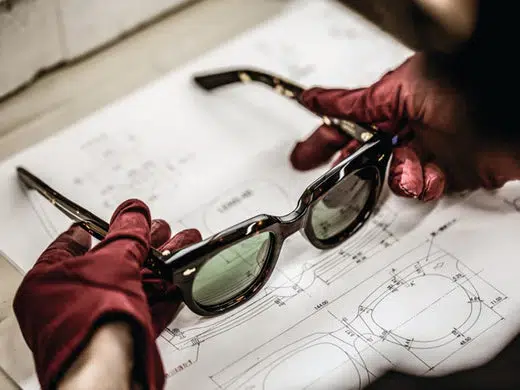
What is monozukuri manufacturing?
Influenced by Shinto beliefs and Zen Buddhism, artisans often viewed natural materials as possessing their own inherent character rather than something to be forced into submission. Instead, the goal was to understand its strengths, limitations, and natural behaviour before guiding it into its most refined form. This approach fostered a philosophy of restraint, balance, and precision that continues to shape how materials such as titanium, acetate, and steel are selected, handled, and finished within Japanese manufacturing.
Although the philosophy is ancient, the term monozukuri was formalised in the late 1990s through Japan’s Basic Technology Promotion Act. This legislation merged factory production with artisan craftsmanship, and repositioned industrial manufacturing as part of Japan’s cultural heritage.
Therefore, with monozukuri as a state-sanctioned standard for modern Japanese eyewear manufacturing, it is visible in every engineered detail. Hinges move with controlled precision. Frame weight is carefully balanced. Components align with micron-level accuracy. Acetate is polished in multiple stages for depth and smoothness. Therefore, every detail reflects a process of continuous refinement rather than mass production.
Why Japanese Glasses Are So Good: Specialist Manufacturing Networks and Vertical Integration
How Is Japanese Eyewear Manufacturing Organised?

One of the lesser-known reasons that answers the question ‘why are Japanese glasses so good?’ lies in how the Sabae eyewear industry is organised. Unlike many large-scale manufacturing centres where a single factory may oversee most production processes, Sabae developed as a specialised industrial cluster consisting of hundreds of independent workshops and suppliers.
Rather than attempting to master every stage of production, many businesses focus on a specific discipline. Some specialise in hinge manufacturing, others in titanium pressing, plating, polishing, surface finishing, temple production, or final assembly. This concentration of expertise allows individual workshops to refine their skills over decades, often passing specialised knowledge through multiple generations. As a result, the Japanese eyewear industry benefits from an unusually high level of craftsmanship and technical precision at every stage of production.
Hence, this specialist manufacturing network is one of the key factors behind Japanese eyewear quality. Frames often pass through numerous highly skilled hands before reaching completion. Therefore, each workshop contributes expertise that would be difficult to replicate within a single mass-production facility.
Why Japanese Glasses Are So Good: Specialist Workshops and Vertical Integration
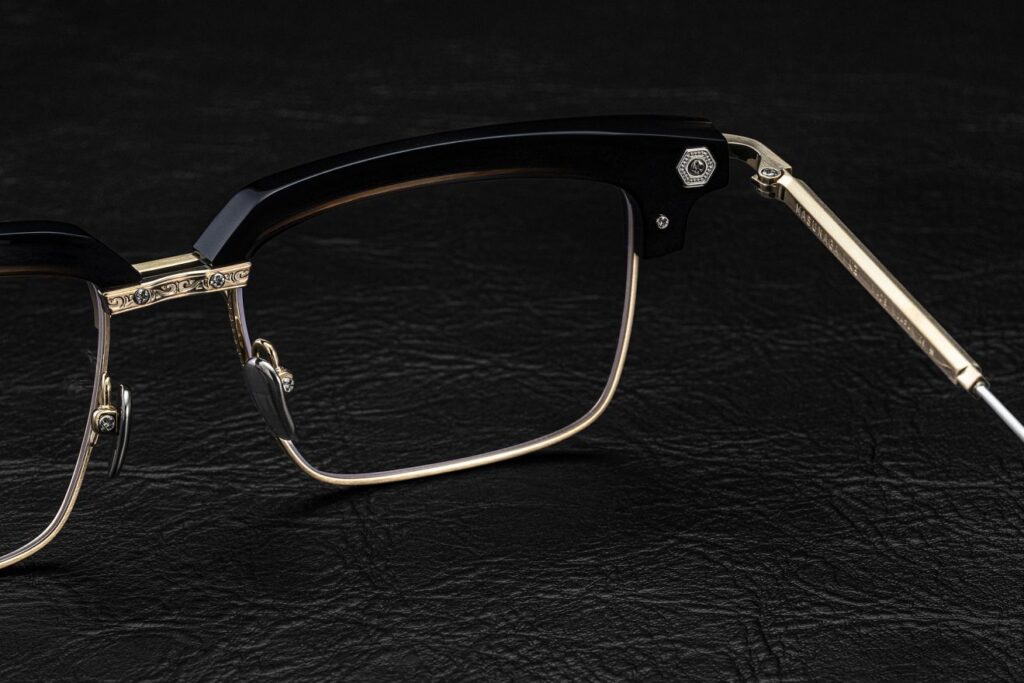
However, a small number of manufacturers operate under a different approach. For example, infamous Japanese eyewear companies such as Masunaga are renowned for maintaining an almost fully vertically integrated production model. As such, Masunaga oversees all stages of production processes, from component manufacturing and frame production, to polishing, assembly, and final inspection. As a result, this level of control enables exceptional consistency, quality assurance, and attention to detail throughout the luxury sunglasses manufacturing process.
Whether achieved through specialist workshop networks or vertical integration, both approaches help explain why Japanese luxury glasses are worth the money. Rather than prioritising production volume, the emphasis remains on precision, durability, and long-term performance.
Functional Beauty and Understated Luxury of Japanese Designer Sunglasses
How Are Japanese Glasses Different From Western Luxury Eyewear?
The influence of Japanese craftsmanship extends beyond manufacturing techniques and into the design philosophy of the finished product. While specialist workshop networks, meticulous quality control, and vertical integration help determine how frames are made, Japanese designers place equal importance on how eyewear performs in everyday life.
Rather than prioritising overt status symbols, many Japanese luxury eyewear brands embrace a concept often described as functional beauty. Frames are designed to achieve harmony between aesthetics, comfort, durability, and practicality. Subtle proportions, balanced weight distribution, refined detailing, and carefully engineered fit are often considered just as important as visual appearance.
This understated approach differs from many Western luxury brands that emphasise prominent logos, bold embellishment, or fashion-driven trends. Japanese designer sunglasses frequently focus on craftsmanship that reveals itself gradually through precise construction, exceptional comfort, and long-term wearability. For many consumers, this combination of engineering precision and restrained elegance is a major reason why Japanese glasses are worth the money.
Why Japanese Titanium Eyewear Is So Highly Regarded
How Japan Became a Leader in Titanium Eyewear
Japan’s leadership in titanium eyewear has become one of the defining strengths of the Japanese eyewear industry, helping explain why Japanese glasses are often regarded as some of the highest-quality frames in the world. Their eyewear developed through a combination of consumer demand, industrial adaptation, and decades of manufacturing innovation.
During the 1960s and 1970s, Japanese consumers increasingly sought lighter and more comfortable, durable eyewear for everyday wear. Traditional materials such as nickel, silver, monel, and stainless steel offered certain advantages. Though, they often struggled to combine low weight, corrosion resistance, strength, and long-term comfort within a single frame.
On the contrary, titanium appeared to offer the ideal solution. The material was originally valued in aerospace and industrial applications for its exceptional strength-to-weight ratio, corrosion resistance, and hypoallergenic properties. During the 1970s, titanium had already attracted interest amongst eyewear manufacturers in Europe and the United States. In fact, pure titanium was valued for its strength, corrosion resistance, and low weight. However, its adoption remained limited due to the difficulty of machining, welding, and finishing the material using conventional eyewear techniques. Thus, these challenges prevented many manufacturers from fully realising the material’s potential for premium Japanese glasses and luxury eyewear.
Where did Japan titanium come from?
Then, as Sabae’s eyewear industry expanded, makers sought stronger and lighter alternatives to nickel, silver and stainless steel. Rather than abandoning titanium due to being difficult to work with, Sabae manufacturers spent years through the 1970s and 1980s adapting their production methods specifically for titanium, which became a focus for innovation.
The breakthrough occurred in 1981, when they overcame the metal’s high rigidity, reactive nature, and propensity for rapid tool wear during machining. Pure titanium’s tendency to absorb oxygen and become brittle at high temperatures necessitated specialised argon-chamber welding and precise finishing techniques. Furthermore, Sabae manufacturers also spent years modifying automotive pressing machinery to handle the rigid material and implementing precise micro-level processing tolerances. Together, these innovations helped establish titanium as a practical and commercially successful material for premium eyewear frames.
Is Japanese titanium good today?
From this point, titanium use evolved quickly. Over the following decades, Japanese manufacturers continued refining these techniques, expanding beyond pure titanium into advanced beta titanium alloys. While beta titanium itself was not invented in Japan, Japanese eyewear makers became some of the earliest and most influential manufacturers to successfully integrate the material into premium eyewear production. Compared with pure titanium, beta titanium offered greater flexibility and resilience, making it particularly well suited to temples, hinges, and other high-stress frame components.
Today, Japanese manufacturers remain internationally recognised for their expertise in titanium eyewear craftsmanship. Their ability to consistently produce lightweight, durable, and precisely engineered frames helped establish Japanese high-end titanium glasses and Japanese sunglasses brands as one of the most respected categories within the global luxury eyewear industry.
Pure Titanium vs. Beta Titanium Glasses: What’s the Difference?
Beta titanium is created by alloying pure titanium with stabilising elements like aluminium and vanadium. This shifts the pure titanium’s crystal structure to a body-centred cubic form, resulting in superior elasticity and fatigue resistance.
Crafting these advanced frames requires sophisticated manufacturing techniques, including utilising laser cutting for intricate geometries, precision milling, and specialised technologies to repeatedly achieve micron-level tolerances.
Pure Titanium Eyewear: Key Features | Beta Titanium Eyewear: Key Features |
| Lightweight: Pure titanium frames are significantly lighter than traditional frame materials, reducing fatigue for all-day wear. | Enhanced flexibility and elasticity: Beta titanium is a specialised alloy that easily bends under pressure and springs back to its original shape without deformation.Beta titanium was developed to overcome the limitations of pure titanium, which is highly rigid, prone to permanent bending, and must be moulded into thicker pieces. |
| Exceptional strength: Pure titanium is highly durable with impressive structural integrity to securely maintain optical alignment. | Superior comfort: Reduces pressure points and creates an adaptable fit, ideal for regular movement and active lifestyles. |
| Corrosion and rust resistant: Pure titanium glasses are less susceptible to damage from moisture, humidity, sweat, and daily wear. | Perfect for temples: Beta titanium is highly utilised in Japanese glasses and luxury eyewear manufacturing. It prevents eyeglass arms from loosening or snapping over time by successfully enduring the high structural pressure placed on temple hinges and ear curves. |
| Hypoallergenic: Being 100 per cent hypoallergenic, pure titanium is an excellent, skin-friendly choice for luxury consumers with sensitive skin or metal allergies. | Optimised for extended wear: Makes a significant difference in day-to-day comfort for individuals wearing sunglasses or glasses for prolonged periods. |
Why Japanese Titanium Eyewear is So Expensive
Are Japanese sunglasses worth the money?
Many enthusiasts view Japanese titanium frames as long-term investments because of their durability, precision engineering, and serviceability.
Working with titanium requires extraordinary manufacturing expertise. Japanese eyewear makers have spent decades refining specialised techniques such as precision milling, intricate welding, laser cutting, and hand-adjusted finishing. Components are often produced to exceptionally tight tolerances, allowing frames to achieve remarkable accuracy, balance, and structural integrity.
This attention to detail contributes directly to longevity. Screws tend to loosen less frequently, hinges maintain their tension for years, and individual components can often be repaired or replaced rather than discarded. Combined with titanium’s inherent strength, corrosion resistance, and lightweight properties, these qualities help extend the lifespan of the frame far beyond many mass-produced alternatives.
For this reason, the best Japanese sunglasses brands are admired not only for their craftsmanship but also for their ability to deliver years of reliable performance. It is this combination of precision manufacturing, comfort, durability, and innovation that continues to make Japanese titanium eyewear some of the most respected in the world.
Frequently Asked Questions About Japanese Glasses
Japanese glasses are distinguished by their combination of craftsmanship, precision engineering, and meticulous quality control. Many frames are produced in Sabae, Japan’s renowned eyewear manufacturing centre, where specialist workshops often focus on individual stages of production such as hinge construction, polishing, plating, or assembly. Combined with Japan’s tradition of monozukuri craftsmanship, this attention to detail helps create eyewear that is lightweight, comfortable, durable, and built to last. Rather than prioritising mass production, many Japanese eyewear brands focus on refinement, long-term performance, and exceptional finishing quality.
Sabae, located in Fukui Prefecture, is widely regarded as the heart of Japan’s eyewear industry. Since spectacle manufacturing was introduced to the region by Gozaemon Masunaga in 1905, Sabae has developed into one of the world’s most respected eyewear production centres. Today, the region produces more than 90 per cent of Japan’s domestically manufactured eyewear and is home to many renowned luxury eyewear brands. Its reputation is built upon generations of specialised craftsmanship, advanced manufacturing expertise, and innovations such as the commercialisation of titanium eyewear.
For many consumers, Japanese glasses are worth the investment because of their exceptional build quality, comfort, durability, and attention to detail. Premium Japanese eyewear often undergoes extensive hand-finishing, rigorous quality inspections, and highly specialised manufacturing processes that require significant time and expertise. While Japanese glasses typically cost more than mass-produced alternatives, many buyers view them as a long-term investment due to their superior fit, refined craftsmanship, and lasting performance.
Japanese eyewear brands frequently use titanium because it offers an outstanding combination of strength, lightness, corrosion resistance, and hypoallergenic properties. These characteristics make titanium particularly well suited to luxury eyewear, where comfort and durability are essential. Japanese manufacturers became internationally recognised for their expertise in working with titanium after developing specialised production techniques that allowed the material to be used successfully in premium eyewear manufacturing.
Beta titanium is an advanced titanium alloy designed to offer greater flexibility than pure titanium. While pure titanium is highly durable and lightweight, beta titanium provides improved elasticity and resilience, allowing frames to flex under pressure and return to their original shape more easily. This makes beta titanium particularly useful for temples, hinges, and other areas that experience repeated stress during everyday wear. As a result, beta titanium is commonly used in high-end Japanese glasses and luxury eyewear.
Japanese and Italian glasses are both highly respected, but they are often valued for different strengths. Japanese eyewear is typically known for precision engineering, technical innovation, titanium expertise, and meticulous manufacturing processes. Italian eyewear, as well as the vast number of Italian luxury brands, by contrast, is often celebrated for bold design, fashion influence, artisanal acetate craftsmanship, and luxury styling. Whether Japanese glasses are better than Italian glasses ultimately depends on personal preference, though both countries produce some of the finest luxury eyewear in the world.

Leave A Comment